当智能体替你工作时,如何保持批判性思维
- Offloading, deferral and surrender
- 卸载、依赖与放弃
- The questions I ask myself
- 用来审视自己的问题
- Verification as a habit
- 把验证变成习惯
- Actually paying attention to what’s generated
- 真正留意生成了什么
- Quality in, quality out
- 高质量输入,高质量输出
- “But the models will be better at this than me”
- “但模型以后会比我更擅长这些”
- Practices for the everyday
- 适合日常采用的做法
- What to bring with you
- 应该带走的原则
- 2. 通俗讲解
Critical thinking when agents do the work
原文链接:Critical thinking when agents do the work — Thread Navigator
作者:Addy Osmani · 双语内容来源:FEEI.CN #786
-
发布时间: Tue Nov 03 07:01:29 +0000 2026
-
发布时间:2026 年 11 月 3 日星期二 07:01:29(UTC)
-
互动: 回复 79 / 转发 154 / 引用 43 / 点赞 1467 / 书签 2604 / 浏览 80125
-
互动:回复 79 / 转发 154 / 引用 43 / 点赞 1467 / 书签 2604 / 浏览 80125
-
原文: https://x.com/addyosmani/status/2117512471930167377
-
原文:https://x.com/addyosmani/status/2117512471930167377
Back in the day, critical thinking was taught as approaching new info with humble curiosity and a healthy dose of skepticism - take in different views, form your own opinion. Still true, but increasingly, nothing in my day-to-day forces critical thinking on me now that so much of my work runs through agents. For the engineers and product people who have fully bought into agentic workflows (running multiple sessions in parallel and expecting the models to improve), I’m here to say: I’m a big fan of these tools. I’m not writing this to advocate for less agentic workflows.
过去,人们教导我们:批判性思维意味着以谦逊的好奇心和适度的怀疑态度面对新信息,吸收不同观点,再形成自己的看法。这一点依然成立,但如今,我的大量工作都通过智能体完成,日常工作中越来越少有事情会迫使我进行批判性思考。对于那些已经全面采用智能体工作流(英文:agentic workflows;这里指由 AI 智能体自主执行任务、并可并行运行多个会话的工作方式)的工程师和产品人员,我想说明:这些工具的忠实拥趸也包括我。写这些并不是为了呼吁大家少用智能体工作流。
My goal is to help you maintain critical thinking in a world where it’s easy to offload anything to an agent.
目的是帮助你在一个几乎可以把任何事情都交给智能体的世界里,继续保持批判性思维。
In the past, most of our cognitive and aesthetic processing happened in the space between question and answer. That space is now measured in seconds. The more you use agentic workflows, the more difficult it becomes (though not in the way I think people expected): as the models improve, the percentage of obvious errors is lower. Many (most?) outputs will be well-written and mostly correct, but they won’t demand a second look.
过去,我们大部分认知和审美加工,都发生在提出问题与得到答案之间的那段时间里。如今,这段时间要以秒来计算。智能体工作流用得越多,保持批判性思考就越困难,不过困难的方式可能和人们预想的不同:随着模型不断进步,明显错误所占的比例越来越低。许多(甚至大多数?)输出会写得很好,而且基本正确,但也因此不会促使你再看第二遍。
Even if you are running many agents at a time, you still only have one pair of eyes on the outputs.
即使同时运行许多个智能体,审视这些输出的依然只有你这一双眼睛。
You have to build critical thinking into your day, because by default nothing will do it for you.
你必须主动把批判性思维融入日常工作,因为在默认情况下,没有任何东西会替你做到这一点。
Part of the reason it’s hard to self-correct for this is that agentic workflows are pleasant. Getting fast, pleasant, often-correct answers is refreshing in a busy day, but that’s also why it’s easy to relax your vigilance.
这种情况之所以难以自行纠正,部分原因在于智能体工作流用起来很舒服。在忙碌的一天里,快速获得令人满意、而且通常正确的答案,会让人感觉轻松畅快;但也正因为如此,人们很容易放松警惕。
Offloading, deferral and surrender
卸载、依赖与放弃
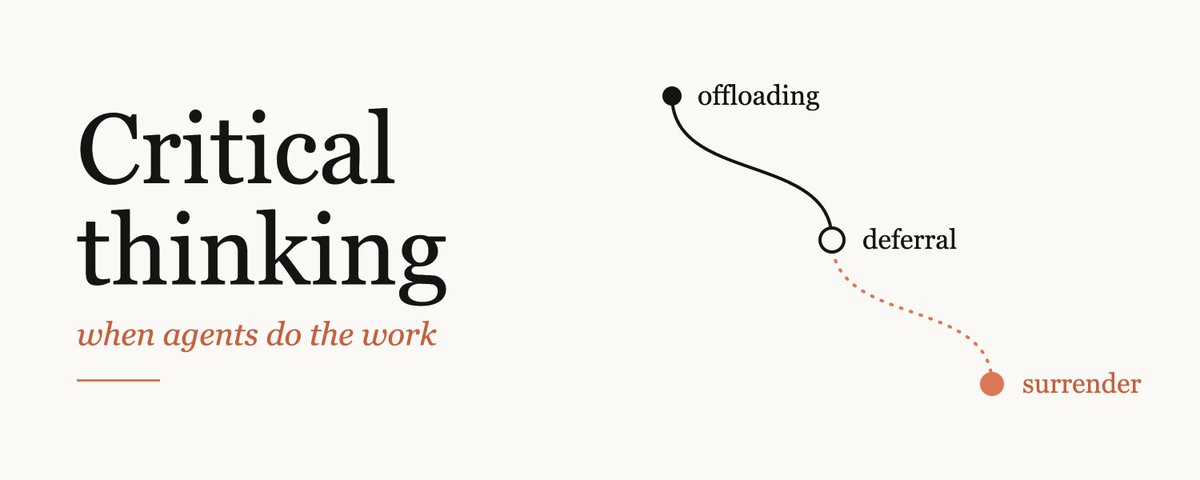
When discussing this with people, I describe it as a spectrum:
和别人讨论这个问题时,我会把它描述成一条连续的光谱:
At the top: cognitive offloading, the act of delegating tasks to the AI, but maintaining ownership of the result. I do this all day. You should, too. In the middle: deferral, where the output of the tool becomes your new input; the result has ceased to be a hypothesis. At the bottom: cognitive surrender - the AI’s output quietly becomes your own, you feel no need to check it.
光谱的顶端是认知卸载(英文:cognitive offloading;这里指把任务交给外部工具处理,但仍由自己理解并负责结果):你把任务委派给 AI,却仍然保有对结果的所有权。这是每天都会做、也是每个人都应该做的事。中间是依赖(英文:deferral;这里指不再独立判断,而是直接把工具输出当作后续工作的既定输入):工具的输出变成了你的新输入,结果也不再被视为有待验证的假设。最底端则是认知放弃(英文:cognitive surrender;这里指不再核查或理解 AI 输出,并在不知不觉中将其当成自己的判断):AI 的输出悄然变成了你自己的东西,而你觉得没有必要再检查。
Cognitive surrender is a term coined by Steven Shaw and Gideon Nave at Wharton. It fits neatly what I’ve been seeing: as trust (or laziness) increases, people drift down the spectrum. The transition is rarely observed, because the steps are each gradual and seem reasonable. You read the last answer well, so you skim the next one. You just scan the skeleton of the one after that. Then you get asked about a line and can’t explain it, even with your agent’s help.
“认知放弃”一词由 Wharton 的 Steven Shaw 和 Gideon Nave 提出。它恰好描述了所观察到的现象:随着信任增加(或者说,人变得更懒),人们会沿着这条光谱逐渐向下滑落。这个转变很少被察觉,因为每一步都很渐进,看起来也都合情合理。上一个答案你认真读了,于是下一个答案只粗略浏览;再下一个,你只扫一眼框架。随后,有人问起其中某一行,你却发现即使借助智能体也解释不清。
That’s cognitive surrender. It’s how cognitive debt accumulates. It’s usually discovered when you try to apply a mental model of the system and it doesn’t exist. Margaret-Anne Storey has written about how this shows up in teams as an eroding understanding of a shared system theory. I’ve written about the code equivalent, comprehension debt (a term coined by Jeremy Twei). In the moment, it’s completely invisible. The codebase looks pristine and the tests pass. It doesn’t become obvious until you have to make a change to the system and realize that nobody understands it anymore. The same applies when you’ve read the table of contents of a strategy doc or spec and signed off on it.
这就是认知放弃,也是认知债务(英文:cognitive debt;这里指因持续依赖外部产出而逐渐欠下的理解与思考能力缺口)的积累方式。人们通常是在试图运用一套关于系统的心智模型,却发现这套模型根本不存在时,才意识到问题。Margaret-Anne Storey 写过这种问题在团队中的表现:团队对共同系统理论的理解会逐渐消退。代码领域也有对应概念,即理解债务(英文:comprehension debt;这里指代码虽然可运行,但维护者对其设计和行为缺乏足够理解;该术语由 Jeremy Twei 提出)。在债务形成的当下,它完全不可见。代码库看起来整洁无瑕,测试也全部通过。直到必须修改系统时,人们才会发现已经没有谁真正理解它了。只看过一份战略文档或规格说明的目录就批准它,也会产生同样的问题。
To be clear, I’m not advocating for the impossible. It’s impossible to maintain the full mental model of a large modern codebase. The Claude Code team has said publicly that they rebuild understanding on demand: when they need to understand a part, they ask Claude to explain that slice, rather than holding the full model in their heads. As I’ve written about before, this sort of debt is more recoverable than most engineers expect. You don’t need to maintain the full model as long as you can rebuild it locally as needed. You just need to know what you don’t have.
需要说明的是,这并不是在提倡不可能做到的事。完整维持一个大型现代代码库的心智模型是不可能的。Claude Code 团队曾公开表示,他们会按需重建理解:需要理解某个部分时,就让 Claude 解释那一小块,而不是把整个模型都装在脑子里。正如此前所写,这类债务比大多数工程师预想的更容易修复。只要能在需要时局部重建理解,就不必始终维持完整模型。你只需要知道自己缺少哪些理解。
Where the stakes are low, feel free to delegate entirely. When you can’t explain the answer to a question, even by way of your agent, you’ve ceded ownership.
在风险很低的地方,完全可以放心地彻底委派。但当你连借助智能体都无法解释一个问题的答案时,就已经让出了对它的所有权。
This isn’t always a problem, either. Just recently, I was recording a course and had to select one out of three similarly-rated hotels to use as a recording location. I didn’t have time to manually review all the reviews, so I delegated the decision to an AI. It worked, and I’d do the same thing again. However, I wouldn’t do that when deciding how to invest our money, how to advise our kids on their careers, or at work: what we should build, what changes affect what users, whether it’s safe to ship. Take the handoff where being wrong is cheap, keep the reasoning where others will have to deal with the consequences.
这也并不总是问题。最近录制一门课程时,需要从三家评分相近的酒店中选一家作为录制地点。没有时间手动查看所有评价,于是把决定交给了 AI。结果很好,以后也会再次这样做。但在决定如何投资家庭资金、如何给孩子提供职业建议,或者在工作中决定该构建什么、哪些改动会影响哪些用户、是否可以安全发布时,就不会这么做。在出错代价低的地方,可以把决定交出去;而当别人必须承担后果时,则要把推理过程留在自己手中。
The questions I ask myself
用来审视自己的问题
When I didn’t know what I thought, I’d usually go back to a basic list of questions like these: How do I know that I’m working on the right problem? How do I know that I’m solving it the right way? Is there evidence that supports my conclusion? How do I know that I’m finished? Most times, this is just who, what, where, why, when and how. When written out, it looks absurdly child-like, but it forces you to think in terms of categories that you’d otherwise ignore. These days, it’s too easy to simply skip all of this and ask your agent what it thinks you should do. These are the new versions of these questions that I ask myself now.
不知道自己怎么看时,通常会回到一组基础问题:怎么知道自己正在处理的是正确的问题?怎么知道解决方式是正确的?有没有证据支持结论?怎么知道工作已经完成?多数时候,无非就是谁、什么、哪里、为什么、何时以及如何。把这些问题写出来,看上去幼稚得近乎可笑,但它会迫使你从那些原本可能忽略的类别出发思考。如今,人们太容易跳过这一切,直接询问智能体它认为该怎么做。下面是现在用来审视自己的新版问题。
Did I formulate a hypothesis before asking? Before I run an agent on any non-trivial task, I write down, even just in my head, what I think the answer might be. It’s OK if it’s a bad guess. You’re always welcome to change your mind in light of new information. Once you’ve read a well-written response, though, it’s hard to imagine any other possibility. If you have no guidance whatsoever, ask for what Thariq Shihipar calls a blind spot pass: give the model what you know and have it find your unknown unknowns.
提问之前,是否先形成了一个假设? 在让智能体处理任何并非微不足道的任务之前,先写下自己认为答案可能是什么,哪怕只是在脑子里想一下。猜得很差也没关系,面对新信息时随时可以改变看法。然而,一旦读过一份行文出色的回答,就很难再想象还有其他可能。如果完全没有思路,可以要求模型做一次 Thariq Shihipar 所说的盲点扫描(英文:blind spot pass;这里指把已知信息交给模型,让它寻找自己尚未意识到的未知因素):把已知内容告诉模型,让它找出你的“未知的未知”。
Am I asking it to help me think or to offload thinking from me? Both are OK, as long as you know which one you’re doing.
是在请它帮助思考,还是把思考本身交给它? 两者都可以,前提是清楚自己正在做哪一种。
What would have to be true for this to be wrong? Then go find out. A model’s self-assessment of confidence is much less valuable than an actual test you can perform, so give it one.
必须满足什么条件,这个结论才会是错的? 接着去查明这些条件是否成立。模型对自身置信度的评估,远不如一项可以实际执行的测试有价值,因此要给它一个真正的测试。
Have I heard the counter argument from a different angle? When I’ve taken a hard stance on something that’s somewhat open-ended, I’ll ask more than one model to argue the opposite side, then review the output and form my own opinion. This takes longer, but I end up knowing much more about the subject.
是否从不同角度听过反方论点? 对某个仍有讨论空间的问题采取强硬立场时,会要求不止一个模型为相反立场辩护,再审阅这些输出并形成自己的观点。这会花费更多时间,但最终会对相关主题了解得更多。
Would I bet on this in front of the person who has to maintain it? This applies to code and to anything else that you’re delivering. I believe that this is the bar for answerability.
敢不敢在未来负责维护它的人面前为此下注? 这既适用于代码,也适用于交付的任何其他东西。这就是判断一个人能否为结果负责的标准。
What am I no longer practicing? Maybe it’s some of the routine debugging. I’m OK with letting some of that go, but I want it to be intentional.
有哪些事情已经不再亲自练习? 也许是某些常规调试工作。放弃其中一部分没有问题,但希望这是有意识的选择。
Verification as a habit
把验证变成习惯
I’ve been writing a lot about verification lately because I believe that the bottleneck has shifted from coding to being sure you’re right. When you give an agent the means to verify what it’s doing, whether that be by way of end-to-end tests, property tests, or by way of actual app interactions, it can make a change, run the verification test, read the output, and attempt again all before you’ve looked at anything. This is what Boris Cherny calls “give Claude a way to verify its work” and I believe that this is one of the most critical components of achieving great results. Rather than reading every line, you’ll be building these loops and reviewing the evidence.
最近写了很多关于验证的内容,因为相信瓶颈已经从编写代码转移到了确认自己是否正确。如果给智能体提供验证自身工作的手段,无论是端到端测试(英文:end-to-end tests;这里指从用户入口到系统输出检验完整流程的测试)、属性测试(英文:property tests;这里指验证程序在大量输入下始终满足某些通用性质的测试),还是与真实应用进行交互,它都可以在你查看任何内容之前完成修改、运行验证测试、读取输出并再次尝试。Boris Cherny 把这称为“给 Claude 一种验证自己工作的方式”,而这正是取得出色结果最关键的组成部分之一。你不再需要逐行阅读,而是要构建这些反馈循环并审查证据。
You can also surrender verification. “Is there evidence that supports my conclusion?” becomes “Did the check turn green?” Agents make it so cheap to create tests that you’ll see a lot of green, and you could have a passing test that doesn’t catch a broken feature. If the test is written with the same mistake as the feature, it’ll pass. And a green check only conveys one property. It’s too easy to imagine it covers everything.
人也可能在验证环节放弃思考。“有没有证据支持结论?”会变成“检查是不是变绿了?”智能体把创建测试的成本降得极低,因此你会看到许多绿色通过标记,但一项通过的测试仍可能没有发现已经损坏的功能。如果测试和功能犯了同一个错误,测试照样会通过。而且,一个绿色标记只传达了某一项性质成立;人们却太容易想象它已经覆盖了一切。
When a check goes green, ask what it proved. Then ask what it didn’t.
检查变绿时,先问它证明了什么,再问它没有证明什么。
Define “verified” upfront, because post-facto, you’ll rationalize any outcome.
预先定义什么才算“已经验证”,因为事后再判断时,人总能为任何结果找到合理化解释。
The finish line for agent work should be something tangible: a test passing, a screenshot, a log or trace. This ensures that the criteria for finishing the work is factual, and not up for interpretation (and surrender) based on something like “it looks like it’s done.” When you receive a finish notification from an agent, before you look at the summary, first review the code snippet of the command executed and its output.
智能体工作的终点应该是某种具体可见的东西:一项通过的测试、一张截图、一份日志或一段追踪记录。这样可以确保完成标准以事实为依据,而不会因为“看起来已经完成了”之类的说法,落入任意解读(以及认知放弃)的空间。收到智能体的完成通知时,在查看总结之前,先审阅它所执行命令的代码片段及其输出。
Claude Code can also self-critique (via a subagent in a fresh context) its own work as a sanity check, and it’s worth baking that into the loop so it runs every time, not just when you remember. I still ask at the end “Did I miss anything?” That sounds silly, but so often, when I finish some complex feature work using a frontier model, look at it, review it, and then ask, “Did I miss anything?” It will then come back with two or three more things. That’s why I always ask.
Claude Code 还可以通过一个处于全新上下文中的子智能体,对自己的工作进行自我批评,作为一次合理性检查(英文:sanity check;这里指快速确认结果不存在明显遗漏或逻辑问题)。值得把这一步固化到循环中,让它每次都自动运行,而不是只在想起来时才做。最后仍然会问一句:“有没有遗漏什么?”这听起来有些可笑,但很多时候,使用前沿模型完成复杂功能、查看并审阅之后,再问一句“有没有遗漏什么?”,它就会补充两三项内容。这就是每次都要问的原因。
None of this needs to be the norm, of course; knowing when to go deep is a skill. My favorite rule of thumb from our write-up on how the Claude Code team does code review is: “If you can’t say what the checks would miss, ask for a real review rather than a quick approval.”
当然,并非所有事情都必须按如此严格的方式处理;知道何时应该深入,本身也是一种技能。在关于 Claude Code 团队如何进行代码审查的文章中,最受认同的一条经验法则是:“如果说不出这些检查可能漏掉什么,就应要求一次真正的审查,而不是快速批准。”
This applies beyond code as well. If an agent has synthesized fifty customer calls for you, or a competitive analysis, check a couple of the source documents to make sure the summary is accurate. Check a number that your recommendation depends on to make sure it’s being calculated correctly.
这一原则也适用于代码之外的工作。如果智能体替你汇总了 50 通客户电话,或者完成了一份竞争分析,就抽查几份原始文档,以确认摘要是否准确。对于建议所依赖的数字,也要检查它的计算是否正确。
Agents have made verification cheap to set up. What’s difficult for you is knowing what good verification looks like.
智能体让建立验证机制变得廉价;真正困难的是知道什么样的验证才算好。
Actually paying attention to what’s generated
真正留意生成了什么
Say an agent gives you a 600-line PR. You roughly look at the structure. You don’t read every line. The variable names look reasonable and the tests pass, so you approve it. But somewhere in the middle there’s a subtle ordering change in a transaction boundary, or a flipped default on an edge case you never thought about. You did review it, I guess, but only for what you already knew you’d find.
假设一个智能体交给你一份 600 行的 PR(英文:pull request;这里指提交给项目、等待审查和合并的一组代码变更)。你粗略看了看结构,没有逐行阅读。变量名看起来合理,测试也通过了,于是批准了它。但在中间某处,可能存在一次事务边界内的细微顺序变化,或者某个你从未考虑过的边缘情况,其默认值被反转了。严格来说,的确进行过审查,但只检查了那些事先就知道要寻找的问题。
Writing code and reviewing it are different skills, and there’s a point where reviewing turns into rubber stamping. So read the diff as if the AI didn’t write it, and then look past the diff at what the agent decided. Over a long session it makes a lot of small decisions for you: the defaults, what’s out of scope, which requirement it reinterprets when two of them clash.
编写代码和审查代码是两种不同的技能,而且审查会在某个临界点变成走过场式盖章。因此,阅读差异内容时,要像它不是由 AI 编写的那样认真;随后还要越过差异本身,查看智能体做出了哪些决定。在一次长会话里,它会替你作出许多细小决定:采用什么默认值、哪些内容不在范围内,以及两项需求冲突时重新解释哪一项。
You won’t see any of that in a summary that says everything went well, so ask it to list the decisions and assumptions it made. Then quiz yourself. Pick a few lines at random and ask, what about this line? What about that one? For a document, close it and try to write out the main argument from memory. Some have a habit I like for long sessions: have Claude write a report on the change, and then give you a quiz at the bottom, where the rule is “I only merge after I pass the quiz perfectly.”
这些内容不会出现在一份声称一切顺利的总结里,因此要让智能体列出它作出的决定和采用的假设。然后测试自己。随机挑几行,问问自己:这一行是怎么回事?那一行又是为什么?对于文档,可以把它关掉,再尝试凭记忆写出核心论点。有些人在长会话中采用一种很值得借鉴的习惯:让 Claude 写一份变更报告,并在末尾出一套测验,规则是“只有在测验中取得满分后,才会合并变更”。
Understand what you’re shipping well enough to defend it. Because at some point, someone could ask.
要充分理解自己正在发布的东西,达到能够为它辩护的程度。因为迟早可能会有人追问。
Agents can also guard your attention. For example, I have an open source project that receives a lot of pull requests. I’ll use agents to help determine what’s incoming, what’s contrary to our guidelines, and where my attention is likely required. I rarely let the agents self-determine this, but they can narrow it down to where I should focus my attention, and then I can actually think about whether these changes are solving the right problem in the right way.
智能体也可以帮助保护你的注意力。例如,有一个开源项目会收到大量拉取请求。智能体可以帮助判断新提交了什么、哪些内容违反了项目规范,以及哪些地方可能需要亲自关注。很少让智能体完全自行决定这些事项,但它们可以缩小范围,指出注意力应该集中在哪里,随后便能真正思考这些变更是否正在以正确的方式解决正确的问题。
Then there’s volume, and you have to be honest with yourself about it. I’ve called this the orchestration tax. It’s the gap between what your agents generate and what you’d feel comfortable putting your name on. If finished work is piling up faster than you can get through it, another session won’t help until you’ve fixed that: tighten the checks so less of it needs you, or slow down.
接下来还有产出量的问题,对此必须诚实面对。这被称为编排税(英文:orchestration tax;这里指协调、审查和整合智能体产出所付出的额外成本):它是智能体生成的内容,与自己愿意署名负责的内容之间的差距。如果已完成的工作堆积速度超过了你的处理速度,那么在解决这个问题之前,再开一个会话也无济于事:要么收紧检查,让更少的内容需要亲自处理;要么降低生成速度。
When you’re producing more than you can stand behind, you’re no longer reviewing. You’re hoping.
当产出已经多到无法逐一为其负责时,所做的就不再是审查,而是在碰运气。
Quality in, quality out
高质量输入,高质量输出
The human mental model is still involved, but instead of in the middle, it’s at the front and end. You’re putting your energy into the front-end of the task description and context, as well as the back-end of reviewing the output. This is why good input is so important to the quality of output, and I view good prompting as a critical thinking skill.
人的心智模型仍然参与其中,只是它不再主要位于过程的中间,而是转移到了前端和后端。你需要把精力投入前端的任务描述与上下文,也要投入后端的输出审查。这就是优质输入对输出质量如此重要的原因,而写出好的提示词也应被视为一种批判性思维技能。
Historically, if you made a non-specific request, someone would challenge it, and you might realize, “Oh wait, I actually didn’t figure this out.” An agent often won’t stop you there. It fills in what you left out and hands back something that looks done, even though the idea behind it is still fuzzy. I’ve written about this as intent debt, the implicit goals, constraints and rationale that may exist in artifacts you didn’t write. Unlike other kinds of debt, nobody else can fix this one for you. The intent has to come from you.
过去,如果提出一个不够具体的请求,别人会质疑它,而你可能会意识到:“等等,其实这件事还没有想清楚。”智能体往往不会在这里叫停。它会补全你遗漏的内容,再交回一个看起来已经完成的结果,即使背后的想法仍然模糊。这个问题被称为意图债务(英文:intent debt;这里指产物中包含了并非由负责人明确表达的隐含目标、约束和理由)。与其他类型的债务不同,别人无法替你修复这种债务。意图必须来自你自己。
Your prompt is a reflection of your understanding of the problem, and if you can’t express it clearly, it may not be clear in your own mind.
提示词反映了你对问题的理解;如果无法清楚地表达它,那么它在你脑中可能也并不清楚。
Write your own request brief in your own words before you ask for help. Describe the audience, out-of-scope items, and the definition of done. When your second round of corrections hasn’t got you there, stop tweaking and rewrite your prompt.
寻求帮助之前,先用自己的语言写一份请求简报。说明目标受众、不在范围内的事项,以及完成标准。如果第二轮修改之后仍未得到想要的结果,就停止小修小补,重新编写提示词。
You can have the agent help you with this too. I like the distinction Andy Clark makes between delegating to an AI system and collaborating with it. In the latter case, you’re in a virtuous cycle of mutual amplification: your prompts sharpen your output, sharpen your next prompt and sharpen your mental model of the problem. If it’s not clear, ask the agent to interview you about what it doesn’t understand. If you close the session having refined your own mental model, that’s a sign of success.
也可以让智能体协助完成这一步。Andy Clark 区分了把任务委派给 AI 系统和与 AI 系统协作这两种方式,这一区分很有价值。在后一种情况下,你会进入一个相互增强的良性循环:提示词使输出更准确,输出又使下一条提示词更准确,同时还会完善你对问题的心智模型。如果某些内容不清楚,就让智能体针对它不理解的地方采访你。如果结束会话时,你自己的心智模型也变得更加精确,那就是成功的迹象。
Also be careful about the input. It’s easy for each agent to just pass the previous agent’s summary into its context, and before long the third agent hasn’t read the original document.
也要谨慎处理输入。每个智能体都很容易直接把前一个智能体的摘要放进自己的上下文;没过多久,第三个智能体可能已经完全没有读过原始文档。
You also need your own standards for output. I’ve played around with AI in lots of different creative mediums, and most of it never gets shown because it doesn’t meet my standards. Things are all coming out nicely formatted and confident, so polish is no longer a useful signal.
你还需要为输出制定自己的标准。曾在许多不同的创作媒介中尝试使用 AI,但其中大多数成果从未公开,因为它们达不到自己的标准。如今,各种产出都格式精美、语气自信,因此表面的精致程度已不再是有用的质量信号。
AI may have made it faster to produce, but if I wouldn’t feel comfortable attributing the output to myself, I won’t output it.
AI 或许提高了生产速度,但如果不愿意把某项产出署在自己名下,就不会把它发布出去。
When something doesn’t meet your standards, note why in shared config, a hook or a test so that it doesn’t happen again. That’s how taste compounds, and noting why something didn’t make the cut is good practice on its own.
当某项结果达不到标准时,要把原因记录在共享配置、钩子或测试中,避免同样的问题再次发生。这就是品味产生复利的方式,而记录某项内容为何未能入选,本身也是一种良好实践。
“But the models will be better at this than me”
“但模型以后会比我更擅长这些”
If you’re as bullish on the future of this space as many people around me are, you’ve probably had this thought for a couple of sections. In a year or two, the model will be able to detect what I’d be able to detect, so why bother maintaining the skill?
如果你像身边许多人一样看好这个领域的未来,那么读到前几节时可能已经产生了这种想法:再过一两年,模型就能发现自己能够发现的问题,那么为什么还要费力维持这项技能?
You may be right on a lot of that detection, and I’ve been arguing for increasingly pushing detection to agents myself. But here’s why I think it still matters: at the end of the day, someone is responsible for what ships. Regardless of how much AI helped, a human has to take responsibility.
关于许多检测工作,这种判断可能是对的,而且一直以来也主张逐步把更多检测任务交给智能体。但这些技能仍然重要,原因在于:归根结底,必须有人为最终发布的东西负责。不论 AI 提供了多少帮助,都必须由一个人承担责任。
The question of how much to trust an agent for any given task is itself a judgment call. Part of staying calibrated is reviewing the work, because what the models get wrong keeps changing. Anthropic’s own research on its engineers and researchers calls out the trap as the paradox of supervision: “supervising Claude requires the very coding skills that may atrophy from AI overuse.”
对于任何一项特定任务,应该在多大程度上信任智能体,本身就是一个需要判断的问题。要保持判断力的校准,就必须审查工作,因为模型容易出错的地方一直在变化。Anthropic 对其工程师和研究人员所做的研究把这一陷阱称为监督悖论(英文:paradox of supervision;这里指有效监督 AI 需要依赖那些可能因过度使用 AI 而退化的能力):“监督 Claude,恰恰需要那些可能因过度使用 AI 而退化的编码技能。”
These are some of the things that matter most to me and that a better model won’t solve: what are you building, why is it worth it, who does it impact and what are you willing to sacrifice? Those are all questions you need to answer. An agent can be helpful in working them through, and I would like it to be, but ultimately they’re still yours.
还有一些最重要、却无法由更好的模型替你解决的问题:你在构建什么?它为什么值得做?它会影响谁?你愿意牺牲什么?这些问题都需要由你回答。智能体可以帮助梳理它们,也确实应该发挥这种作用,但归根结底,这些问题仍属于你。
You may offload the work and much of the auditing, but not the accountability.
可以卸载工作,也可以卸载大量审查,但不能卸载责任。
Practices for the everyday
适合日常采用的做法
You don’t need to do all this rigorously. Just plug in what works for your workflow.
不必严格执行所有做法,只需把适合自身工作流的部分融入其中。
Once a week, write a bit of code without an agent, or do one real thing that would suck if you forgot how to do it. (I’ve called this a calibration exercise, but I don’t mean it as a moral one.) Once a month, write down what you’ve stopped doing and decide which of those you’re okay not doing. One question from an old blog post of mine remains as valid as ever: How lost would you be if AI didn’t exist?
每周在不使用智能体的情况下写一点代码,或者亲自做一件一旦忘记方法就会很糟糕的实际工作。(这曾被称为校准练习,但并不是要对它作道德评判。)每个月,写下自己已经不再亲自做的事情,再决定其中哪些确实可以放弃。一篇旧博客文章中的问题至今依然有效:如果 AI 不存在,你会变得多么不知所措?
If something is above your comprehension, go learn it. If I’m writing and I run into a phrase I haven’t seen before, I could Google a one-line explanation and include it. I prefer to do a little research to properly understand it, so I can see where it fits.
如果某件事超出了自己的理解范围,就去学习。写作时遇到一个从未见过的说法,当然可以用 Google 搜索一句话解释,然后把它写进去;但更倾向于做一点研究,真正理解它,从而知道它应该放在什么位置。
Checking the machine properly is real work, and pretending otherwise is how teams end up not doing it. It isn’t free, so schedule it as a line item and you’ll actually get it done.
妥善检查机器的产出是真正的工作。假装它不算工作,最终只会让团队彻底不做这件事。检查并非没有成本,所以要把它作为一个明确的工作项排入计划,这样才会真正完成。
Skills that you stop exercising are going to go away, and probably faster than you might guess. Keep doing the ones you’re not willing to let go.
停止练习的技能终将消失,而且速度可能比预想的更快。 对于不愿失去的技能,要继续亲自使用。
What to bring with you
应该带走的原则
-
Be intentional. An agent can quiz you, interview you and show you its evidence, but only if you set that up. So set it up.
-
有意识地行动。 智能体可以测验你、采访你,也可以展示证据,但前提是你预先建立了这些机制。所以,把它们建立起来。
-
Be honest about your place on the spectrum. If you can’t explain the answer, even with an agent’s help, you’ve surrendered it.
-
诚实面对自己在这条光谱上的位置。 如果连借助智能体都无法解释答案,就已经放弃了对它的掌控。
-
Have a hypothesis. Formulate one before asking, even if it’s bad.
-
先有一个假设。 提问之前先形成假设,即使猜得很差也没关系。
-
A green check means one thing. What did it check? What did it not check?
-
一个绿色标记只代表一件事。 它检查了什么?又没有检查什么?
-
Look for evidence. Read what it ran and what it returned before reading the summary.
-
寻找证据。 阅读总结之前,先查看它运行了什么,以及返回了什么。
-
Read to know what decisions it made. What did it decide for you?
-
通过阅读弄清它作出了哪些决定。 它替你决定了什么?
-
Craft your prompt. How you write what you prompt shows how much you understood the problem.
-
认真打磨提示词。 如何表述提示,反映了你对问题理解到了什么程度。
-
Set a bar, and stick to it. If you wouldn’t put your name on it, it doesn’t go out.
-
设定标准,并坚持到底。 如果不愿意署上自己的名字,就不要把它发布出去。
Keep yourself in the game by manually applying the skills that matter. One thing you could do: Before you ask, write down what you think will happen, and after the agent is done, write down one thing it didn’t check. Let me know if that changes the way you read the output. Think independently. Ask better questions. Take responsibility for the outcome.
通过亲自运用重要技能,让自己始终留在工作过程中。可以先从一件事做起:提问之前,写下自己认为将会发生什么;智能体完成之后,再写下一项它没有检查的内容。看看这样做是否会改变你阅读输出的方式。独立思考。提出更好的问题。为结果负责。
2. 通俗讲解
智能体真正带来的风险,不只是它偶尔会答错,而是它越来越经常给出流畅、合理且基本正确的结果。这种输出不容易触发警惕,人也就会从“把任务交给 AI、自己仍负责结果”,逐渐滑向“直接把 AI 的答案当成事实”,最后甚至无法解释自己批准和发布的内容。认知债务正是在这个过程中积累的:代码可能整洁、测试可能通过,但真正需要修改系统时,团队才发现没人理解它。
是否应该把任务完全交给 AI,要看出错成本。选择录课酒店之类的低风险决定可以彻底委派;投资、孩子的职业建议,以及产品该做什么、会影响哪些用户、能否安全发布等高风险问题,则必须保留人的推理和责任。判断自己是否已经过度依赖 AI,有一个直接标准:如果连借助智能体都无法解释答案,就已经让出了对结果的所有权。
验证不能简化为“测试变绿了”。一项测试只能证明它实际检查到的性质,写错的测试甚至可能与错误实现一起通过。更可靠的做法是预先定义完成标准,让智能体提供具体证据,例如通过的测试、截图、日志或追踪记录,并追问每项检查证明了什么、没有证明什么。面对 600 行 PR、50 通客户电话的摘要或竞争分析,也不能只看漂亮的总结,而要抽查源材料、关键数字、智能体采用的假设和它替人作出的决定。
人的思考并没有从工作流中消失,而是转移到了前端和后端:前端要把问题、受众、范围和完成标准表达清楚,后端要审查结果和证据。含糊的提示词往往意味着提问者自己尚未想清问题,而智能体会自动填补空白,制造出“看起来已经完成”的结果。更有价值的协作,是让 AI 追问不清楚之处,并在交互中反过来完善人的心智模型。
即使未来模型能承担更多检测和审计工作,人仍不能把责任一并卸载。监督 AI 所需要的技能,恰恰可能因过度使用 AI 而退化。因此,应定期在没有智能体的情况下练习重要技能,控制产出量,并只发布自己愿意署名负责的成果。最简洁的实践是:提问前写下自己的假设,智能体完成后写下一项它没有检查的内容,然后独立判断、继续追问,并对最终结果负责。
Enjoy Reading This Article?
Here are some more articles you might like to read next: